Memories of Dutton’s Island

By Richard Houghton Morrison

The island is located in Umbagog Lake in Errol, New Hampshire. My grandfather Harry Dutton built a camp on this island 1898-1905. I was told that the cost to build the camp was around $105,000, which today would be in the millions.

I am Richard Houghton Morrison, the last living grandchild of Harry Dutton. My mother was Alice Dutton Morrison, youngest daughter of Harry. I spent every summer at the island from age six months to seventeen years old.

I am going to take you on a written tour of the island as I remember it.

We used to land our boat at the inlet on the east side of the island. Located there was a wooden wharf and granite steps to the island.

The main house was on the right and straight ahead was the ice house. This was a building approximately 20′ by 30′. Inside was a bulkhead that contained sawdust. In the winter, workers would cut out blocks of ice to be used in the two large ice chests located in a pantry off the kitchen. The ice blocks were stored in sawdust.

We will now proceed south to a building called the Guides’ Camp. As you entered this building you were in a hall. In a room on the left were two large Kohler diesel-driven generators that delivered DC current for the lights at the camp. Two rooms on the right housed gasoline-engine-driven water pumps. These pumps pumped water from the lake to a large tank located near the top of the lighthouse. The water from the tank fed the flush toilets and sinks located in the five bathrooms. It also fed the sinks located in the kitchen and pantry. Moving down the hall, a utility room was on the left and on the right was a bathroom, and then stairs to the attic that was used for storage. At the end of the hall there was a large living room with a big potbelly stove in the middle.

There were four bedrooms and two were located on either side of the living room. The help lived here and had their meals in the kitchen of the main house.

We will now head north to the main house. When we arrived for the summer we would always enter the house through the kitchen. You entered the pantry that contained the two large ice chests, one on either side.

We now proceed into the large kitchen; countertops on the left, large sink at the end. In the middle of the back was a large, black, iron, wood-burning stove with two ovens controlled by a damper in the flue. The west wall had various cabinets and a door to the porch. On the north side was a very large table and chairs where the help ate. Next to the table was a doorway entering into a large pantry that contained a sink and many cabinets. Also located here was the maid-calling station. From this pantry on and throughout the entire camp, only cherry wood and tulip wood was used on all walls and ceilings.

We now enter the dining room through swinging doors. The dining room had a large table that could be enlarged with leaves. We used the table at its smallest size (eight chairs). It could be enlarged to seat sixteen. Windows on the west side afforded a beautiful view of the lake and mountains. On the east side was a large fireplace with a lovely mantel piece. The ceiling in this room and the living room was sixteen feet high.

I am now going to take you to the front door entering the living room. I can better explain this room from the entrance. As you entered this room you were looking at a huge fireplace with a large bull moose mounted over it. To the left was a tall music box that played large, round, metal disks with holes in them. On this side of the room was the door to Harry and Alice’s bedroom. Next was a large, red velvet couch with ornate gold armrests. Next to this was a large piano and as we turned the corner a cabinet holding cue sticks and pool equipment was located here next to the fireplace. On this side of the room was a standard-sized pool table. Continuing on past the fireplace you came to the open entrance to the dining room. On the west wall were chairs, tables and lamps. One chair of interest was Harry’s buffalo chair done in an off-red leather with actual buffalo horns. An L-shaped couch with large cushions was in the corner. On this side of the room were many chairs and tables. Around the periphery of the room about ten feet up were deer heads, lynx heads, stuffed fish and many other animal heads. A stuffed black bear cub was located next to the fireplace on the right. The cub held an ashtray in his paws.

HarrysCampFloorplan

We will now proceed into Harry and Alice’s bedroom, which was off the living room. This was a large bedroom with twin beds, two large bureaus, a table with a lamp between the beds and a large fireplace. The master bath had a tub, fireplace, sink and a flush toilet. Off of this bedroom was Harry’s den and office. This room was small and had a fireplace with a bench seat on either side, somewhat like a booth at a restaurant, but larger. On the other side of the left bench seat was a large rolltop desk. Harry had a back door in this room so he could leave without being disturbed. Next to this room was a large walk-in closet.

Next was a corner bedroom with twin beds, dresser, table, private bath and a walk-in closet. This was the bedroom I slept in. This room also had a fireplace.

We now proceed to four similar bedrooms, all with brass double beds, dressers, walk-in closets and a fireplace. These rooms shared two bathrooms. The end bedroom was larger with a double bed, private bath, fireplace, dresser, tables and a walk-in closet. All bedrooms had their own door leading to the large wrap-around porch. The porch had five large stairways to the ground, one on the east, two on the north and two on the west.

A double door entrance at ground level near the wharf led you into a storage area that ran under the porch around the entire periphery of the camp. In here were canoes, rowboats, wood storage piles, boxes, boxes of clay pigeons for skeet, and many other miscellaneous items.

The entire U-shaped main house had a large porch all around it. The northwest corner of the porch had a walkway to the lighthouse. The lighthouse was built to house a large water tank near the top. As you walked into the lighthouse, you entered a room with all kinds of closets and cabinets that were used for storage. On the left of the the room was a stairway that circled around the water tank and took you to a room at the top of the lighthouse. This room had a large light that was used as a beacon at night. There was a circular walkway around the top of the lighthouse, with a great view in any direction.

Corrections

Richard E. Pinette, Northwoods Echoes (the author, 1986), 15-20:
— The Ojibway was 30′ long, not 26′.
— The solid brass cannon was mounted on a steamboat named the Valantta.
— The stone watchtower was actually called the lighthouse.
— There was not any pipe laid across the lake to Tyler Cove. Drinking water came from a natural spring located in B Cove. A wooden trough was installed from the spring to the edge of the lake. Five-gallon cart boys were filled here.

Joseph Crook Anderson II, The Duttons of Glen Rock, Malden, Massachusetts: An Updated Account (the author, 2013), 74-78:
— Richard H. Morrison was born in 1931.
— The main house on Dutton’s Island was U-shaped, not circular. Harry and Alice’s bedroom was located next to the living room in the front of the camp.
— The room off the master bedroom was not a card room. See my description above.
— The living room had only one large fireplace.
— The porch extended to the lighthouse at the northwest corner.
— My grandfather had a telephone line laid on the bottom of the lake to Tyler Cove. The line then ran to the lake house hotel in Upton, Maine.


Nina Dutton’s Engagements: Testing the Family Lore

The story that has been passed down in the family has never lacked for sensationalism:

Nina Dutton, the youngest daughter of B. F. Dutton, fell in love with a local doctor and they soon became engaged. Great preparations were made for the wedding. Invitations were sent out and presents were pouring in. But suddenly one day, a woman with a baby in her arms visited B. F. Dutton in his offices at the Houghton & Dutton store and showed him papers proving she was married to Dr. Jones. The marriage was immediately called off and poor distraught Nina was sent to Europe to her Aunt Ellie to recover. Upon her return to America, Nina met John Everhart, a lawyer from Pennsylvania, and they were soon married at Glen Rock, the ceremony being a much smaller affair than the original one planned for her. A few years later, Everhart died suddenly, leaving Nina with two small children. Nina eventually got back together with Dr. Jones and they were married, but against the wishes of her family. The resentment against Dr. Jones among the Duttons was such that he and Nina moved away from Malden to Cape Cod, where they lived the remainder of their lives.

That is the official story. Newspaper accounts, however, reveal it was more complicated than that.

Massachusetts vital records show that Nina and John Everhart were married on September 19, 1900. If the official story above is true, then it can be estimated that her ill-fated first engagement to Dr. Jones probably took place about 1898 or 1899. Surprisingly, the first engagement notice found for Nina in the Boston papers is dated several years earlier than that, and the intended groom was not Dr. Jones!

In the Boston Daily Advertiser of November 2, 1896, the following announcement was published:

Engagement1

At the time of this announcement, Nina was 21 years old and Everhart was 37. For reasons unknown, the marriage did not take place, but this shows that Nina did not first meet Everhart after calling off her engagement to Dr. Jones. She had known him much longer than that.

On January 27, 1898, more than a year later, Nina applied for a U.S. passport, stating that she was “about to go abroad temporarily” and that she “intend[ed] to return to the United States in six months.” A week later, the Boston Herald reported that “Mrs. B. F. Dutton went over to New York on Friday with her daughter, Miss Nina Dutton, who sailed on the North German Lloyd Line yesterday for a four months’ trip abroad.”

Nina was back home in Malden by the summer, since on September 19, 1898, her engagement to Dr. Jones was reported in the Boston Daily Advertiser:

Engagement2

Nina was now 23 and Dr. Jones was a 33-year-old physician with an established practice in Malden. What is particularly extraordinary about this announcement is that it was published on September 19 and the wedding was scheduled for October 6—only two weeks and three days later! This was definitely not the large wedding that family tradition claims was being planned, there hardly being enough time to send out invitations and receive the multitudes of presents that were supposedly flowing in.

It is unclear why the youngest daughter of one of the Boston area’s most prominent families would have wanted such a rushed wedding, and there is obviously more to this story than we know. The “woman with the baby” claim seems doubtful, however, as there is no official Massachusetts vital record that Dr. Jones had been previously married and no record of his fathering a child. Nevertheless, whatever happened, Dr. Jones became persona non grata within the larger Dutton family and again Nina’s engagement was cancelled.

Nina promptly went off, or was sent off, to Europe. While there was no notice of her departure in the Boston papers, the Malden newspaper reported in early July 1899 that Mr. and Mrs. [B. F.] Dutton and Mr. and Mrs. George Dutton “all sailed on the New England this week to pass a few weeks in Europe, to join Mrs. J. B. Claus [i.e., their daughter Ellie] and Miss Nina Dutton, who have been abroad a year [sic].” Mr. B. F. Dutton and wife, Mr. G. C. Dutton and wife, and Miss Nina Dutton all returned to Boston on the New England, which sailed from Liverpool on October 12 and arrived in Boston on October 20, according to the ship’s passenger list.

The rest of Nina’s story falls in line with the family tradition. She became re-engaged to John Everhart and married him the next year. Daughters Helen and Mary were born in 1902 and 1904, respectively. Everhart died the same year Mary was born, and Nina moved back to Glen Rock with her two small children. By 1908 she was seeing Dr. Jones again and they were married in a very small ceremony in Hillsboro, N.H., on September 29.

When B. F. and Harriet Dutton had their 50th wedding anniversary celebration in March 1910, Nina and her family did not take part in the festivities, at least none of them were present for the elaborate family portrait taken on the occasion. The month after the party, Nina’s son Louis B. Jones was born in Malden, and soon after the Joneses moved to Falmouth on the Cape and lived there the rest of their lives.

Nuptials for BF Dutton’s Great Great Great Granddaughter

On Saturday, July 12, Lizzie Anderson married Neel Ray in New York City. Lizzie is a daughter of the late Harry B. Anderson III, granddaughter of Claire Matz Anderson of Princeton, N.J., great granddaughter of Claire Dutton McGregor Matz, great great granddaughter of Claire Dutton McGregor, and great great great grandaughter of Benjamin Franklin Dutton. In addition to Lizzie, B.F. Dutton descendants in attendance were her grandmother Claire Matz Anderson; uncles Alexander M. Anderson, Joseph C. Anderson, and Jeffrey M. Anderson; sister Claire M. M. Anderson; cousins Alexander M. Anderson Jr., Christopher A. Anderson, Sara B. Anderson, Louise E. Anderson, and Stephanie M. Anderson; and first cousin once removed Jennifer Horn Schuppert. It was a happy occasion enjoyed by all.

From The New York Times:

AndersonRay Wedding

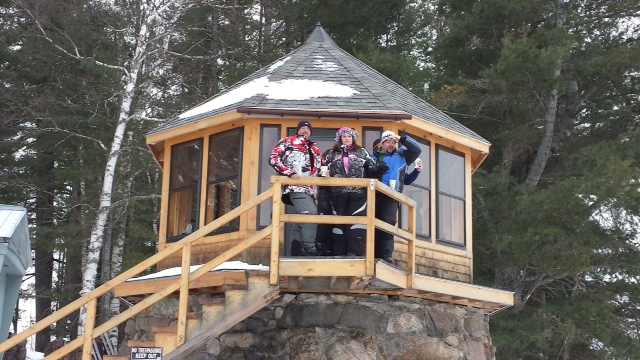
Harry Dutton’s Lighthouse Today

The power of the Internet never fails to amaze me! Yesterday evening, I received an email from Mark [last name not given] who is familiar with Metallak Island in Lake Umbagog, the site of Harry Dutton’s camp. It would seem that Mark lives in the area and had seen this blog. He wrote:

 I took this picture of the lighthouse over the winter. The current owner built a gazebo on the old foundation. There has been a mobile home on the island for years. The old foundations are still intact. If I get a chance I will try to get you current pictures of the island.

The two pictures he attached are shown below:

Lighthouse Gazebo

Metallak Island mobile home

This confirms that the two structures seen on the aerial photo of the island (see my blog post below of April 3, 2014) are indeed the lighthouse and the mobile home pictured above.

My thanks to Mark for taking the time to send these interesting photos.

New Images of Glen Rock

Last Saturday, I delivered the keynote address at the Southern Maine Genealogy Conference, which was held in Portland, Maine. My topic was “Documenting Grandma’s Stories: Turning Gossip into Genealogical Fact.” My subject matter, of course, was the Duttons of Glen Rock, and the audience was most receptive to my detailed account of Malden’s first family of the Gilded Age.

On Sunday, I drove to Malden to visit my friend Marilyn Glover. Marilyn is on the board of the Malden Historical Society and it so happens she has lived all of her life right across East Border Road from the main entrance to Glen Rock in one of the twin houses that B. F. Dutton built for some of the workers in his large stable. I had first made contact with her several years back when she was working on a talk to the historical society on the Duttons and I was independently working on my book. It’s a small world!

The weather was perfect. With Marilyn, her sister Linda, and a number of interested neighbors, we spent about three hours walking all over the old Glen Rock grounds, looking at the houses that are there today, figuring out the former locations of B. F. Dutton’s Ticonderoga cannon, the flagpole, the tennis court, the well house, and the grape house, and looking for any remnants still visible of the Dutton estate. We walked into the woods and saw the foundation of the barn and we climbed Tea Rock to see the view of downtown Boston that my grandmother described. In my next posts, I will include some of the photographs that I took on the tour of the property and try to give you a sense of how it is today.

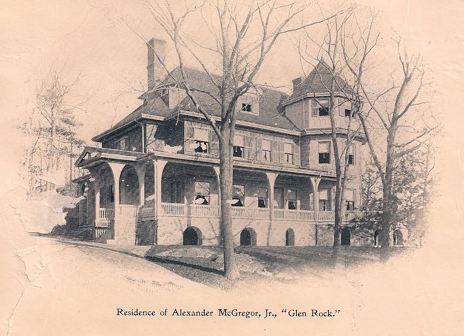
In the meantime, I will leave you with three new pictures that Marilyn had uncovered at the historical society. The first is a drawing of the McGregor house from an old book that had sustained some water damage. This picture is similar to the one I published in my book, but a bit more detailed. Of particular interest, the tree in the foreground of the picture below was recently cut down and the stump–of course much larger around one hundred years later than shown here–is still in the ground. It helped orient me to the exact location of the original McGregor house. A smaller house now stands on that lot in exactly the same spot.

AlexanderMcGregorHouse

The second picture from the same book is of the south facade of B. F. Dutton’s house at Glen Rock. This one is also similar to the two pictures of the house printed in my book.

BFDuttonHouseMarilyn

For me, the most exciting picture is the third one that Marilyn produced, showing the east facade of B. F. Dutton’s house. I had never before seen a picture of that side of the house. This is the view that the visitor would have had of the house approaching from the Summer Street entrance to the property. You can see that this view is around to the right from the view above. Looking at the two pictures together, one gets a sense of how large (and beautiful) the house was and how perfectly maintained the landscaping was (click on the picture below to get a larger image on your screen).

BFDuttonHouseEastFacade

The Malden Historical Society has undertaken the project of organizing its materials, many of which have not been properly classified and curated. Until now, no one there has been able to locate any photographs of the Glen Rock properties. This seems odd to me since the houses and the barn stood as late as the 1930s. Maybe in the process of reorganizing everything, someone one day will uncover a stash of old photographs.

Additional Notes on Harry Dutton’s Camp

I recently purchased a copy of the book Northwoods Echoes, written and published privately in 1986 by Richard E. Pinette. Chapter 2 is titled “Dutton’s Island” and describes in entertaining detail Harry Dutton’s camp at Lake Umbagog in Maine. According to this book, the island was called by the locals “The Million Dollar Island” because of the money that Harry spent to build his summer home in the middle of Lake Umbagog. According to Pinette, the house, with its seven large bedrooms

. . . was beautifully designed to blend with the natural beauty of the island and the surrounding lake. Its interior was finished with exotic wood panels from distant parts of the world. The red-shingled roof, the first one of its kind in the entire region, sloped down to cover the wide porch which went completely around the mansion to offer breathtaking panoramic views for the guests as they sat outdoors in their comfortable rocking chairs, enjoying the cooling lake breezes during the hot summer days.

Pinette adds that Harry Dutton hired the finest cooks to prepare meals, as well as waiters and servants who served them in the beautiful dining room of the camp, decorated with parqueted wood floors, Persian rugs, and wood-panelled walls with mounted trophy heads from Harry’s hunting and fishing expeditions. The servants lived in separate servants’ quarters on the island (visible in the movies that I posted in the last blog post).

The Duttons love for the game of golf has been well documented, and an island in the middle of the rugged northwoods did not prevent Harry from participating in the sport:

[He] found a spot on the shore of the mainland and he had his own private golf course carved out of the forest at a place known as “Tyler Cove.” Recently this writer [i.e., Pinette] made a special trip to that area to try to locate the site of the old golf course, now completely grown over with trees. With the aid of two foresters . . . the exact spot was located. Still distinguishable are a couple of the greens, now with spruce and fir trees up to fourteen inches in diameter growing out of what was once the putting surface.

With no suitable water supply available on the island, Harry Dutton laid a special pipe across the water on the lake bottom to bring fresh water from Tyler Spring on the mainland using mechanical pumps. A few years after the house was built, the windward shore of the island began to show signs of erosion.

Hundreds of huge blocks of quarried stones weighing several tons each were hauled across the lake ice in the winter months and . . . were used to erect a mighty sea wall and boat slip. The exquisite stone work resembled the walls of an ancient castle moat and they are still visible to boaters today.

In the 1940s, the Union Water Power Company, which controlled the level of the lake, developed plans for a larger and higher dam at Errol, New Hampshire, which would completely flood the island. The company purchased the island from Harry Dutton’s heirs and hired a contractor to dismantle and remove all of the buildings from the island. The buildings were torn down during the winter months and the materials were taken away over the lake ice. Ironically, the construction of the bigger dam never materialized. When Pinette wrote his account in 1986, he reported that the island was then leased to a married couple who used it as a weekend retreat. While the big house was gone, the massive stone walls built to prevent erosion were still intact, as was also the lighthouse. Although I cannot say for sure if the lighthouse survives today in 2014, a close-up aerial photo of the island from Google Maps shows a rounded construction that seems like it could very well be the lighthouse.

Metallak Lake

This rounded structure is located on the north side of the island, just to the left of the lone house in the photo, and is seen better in this closeup:

Metallak Lake Rounded Structure

As it turns out, surprisingly, Harry Dutton’s large house has not completely disappeared. When the buildings on the island were razed, one of the wings of the mansion was cut away from the rest of the building and moved six miles over the ice to a spot just off Mill Road in the town of Upton, Maine, where it was set up on concrete supports. In 1986 it formed a section of the home of a young married couple. They had made some renovations, but most of the original interior had been preserved.

One room in particular has been left virtually intact, just as it was in those days of grandeur. We visited the room which had been the formal dining room. The refined grace and richness is still evident on every side. The sixteen-foot cathedral ceiling, which seems to reach for the sky, is of parqueted solid wood sections, each about three feet square and accentuated by criss-crossing heavy beams. The solid imported wood is tulip wood with a natural finish the color of honey, with a rich and deep tone instead of a shine. The walls are of the same pleasing patterns. One end of the preserved room is covered with wood and glass china closets built into the wall and divided by a solid wood, five-panel door, leading to what was then the pantry, a place where lights were displayed to signal the maids. . . . The wing of the Dutton mansion which was saved from destruction also included a section of the spacious porch which has now been closed in for an additional room. The original double-hung windows, which had faced the lake, are still in place and in good condition.

Pinette ends his account by noting wistfully that the island in the waters of Umbagog Lake is now just a skeleton of its former self:

Gone are the affluent guests, the maids and the servants of that grand era. Gone also is what was once perhaps the grandest mansion in these parts. . . . But the memories of the once glorious island live on, and the massive stone work which remains serves as a silent reminder of the magnificent days of Dutton’s Island, the “Million Dollar Island” in the heart of the northland.

Vacationing at Harry Dutton’s Camp

Dick Morrison is the last person alive who remembers spending the summer at his grandfather Harry Dutton’s camp on Metallak Island in Lake Umbagog. Until he was seventeen years old, he would go there with his family and spend a month every summer. The following videos are clips from family movies in Dick’s possession. These movies were taken in the 1930s and show his parents, his brother, and other members of the extended family enjoying their time at the camp.

In this first video, we approach the camp, as all visitors did, by launch from the mainland. The most prominent feature of the camp was the lighthouse, which according to Dick was a disguise for a large water tank, pumped full from the lake and used to power the camp’s plumbing system.

A summertime visit to the camp offered many types of outdoor activities, including fishing, boating, canoeing, swimming, badminton, and shooting, all of which can be seen on the next video.  In the first badminton clip, Alice (Dutton) Morrison, Dick’s mother, shows her form in the near court competing against her husband, Arthur W. Morrison. In the second clip, the older player on the near side is Harry Dutton’s son-in-law, Erving Morse, who was the last president of the Houghton & Dutton store. The shooters are Dick’s father, brother, and mother–Arthur W. Morrison, Arthur D. Morrison, and Alice. The boy in the canoe with the dog is Arthur D. Morrison.

Dick Morrison has very fond memories of visiting the camp, and has promised to put together a recording describing it in more detail, which I hope to post some time in the future. In the meantime, we will take one more tour around the camp by water before heading back to the mainland. What a fun and relaxing place the camp must have been, for both humans and dogs!

Harry Dutton’s Camp

Harry Dutton’s lavish “camp,” located on Metallak Island in Lake Umbagog (just outside the town of Upton, Maine), was a popular summer vacation destination for all of the Duttons.

Upton, Maine

Lake Umbagog2

The camp was built in 1898-99 and remained in the possession of Harry’s descendants until the 1940s when it was eventually sold.

The construction of the camp was an event of much interest to the local population, as evidenced by this story published on the first page of the Lewiston [Maine] Sunday Journal, on 19 November 1898:

Bethel, Me., Nov. 19 (Special). The people of Bethel and vicinity are much interested in Upton, where Mr. Dutton of the well-known firm of Houghton, Dutton & Co., Boston, is erecting a summer house on Metalluck Island in Umbagog Lake. Bethel has often expressed a desire for railroad connection with the large lake country lying northerly of it, but now many think that the future holds more in store for this region if this vast territory is left undisturbed by the railroad. Development inevitably follows in the wake of the railroad and the wilderness of the great forests no longer remains. The territory now lying northerly of Bethel, and made up of Newry, Grafton, Upton and the lower Umbagog region still remains comparatively unbroken in its seclusion. Here the sportsmen can find immense tracts of almost virgin forest, and haunts as wild and rugged and unbroken as they were two centuries ago. Each year many come to this section from other states and enjoy its exceptional sporting facilities. But until recently no move has been made toward the development of the country as a summer retreat.

Mr. Dutton not long ago purchased Metalluck Island of its owners in Upton and at once began to get it into suitable condition for building. The island contains two or three acres and receives its name from the famous Metalluck, the last of the Androscoggin tribe of Indians, who for a long time dwelt on the shores of Umbagog lake and near this point. Mr. Dutton has built a breakwater of rocks around the island, so that its shores are fully protected. The house is being built near the shore and follows its contour to quite a degree. It is one story in height and the front will be 117 feet in length. There will be two wings, one of which will be 97 feet long and the other 77 feet. The building will be of considerable width and will cover quite a surface, thus affording accommodation for a large number. It will contain many fireplaces and will have all conveniences. Mr. Dutton intends to erect a lighthouse on the head of the island and undoubtedly will change the entire island into a veritable paradise of a summer retreat. Mr. Dutton has a nice summer house near Rangeley, but the railroad and its followers are not to his liking when seeking recreation. He had been in Upton looking after his interests but the charge of the entire matter is in the hands of Mr. Alva Coolidge of Upton. A large crew of men are at work upon the building and the outside work is being hastened as much as possible.

Stay tuned for my next blog post, in which I will take you on a boat tour around the island, compliments of Harry’s grandson Dick Morrison, and perhaps we’ll also be able to get in a game of badminton.

Four Generation Family Photograph

The following photo, contributed by my first cousin Jennifer (Horn) Schuppert, includes four generations of the Dutton/McGregor family. From left to right, the photo shows Clara (Dutton) McGregor, her mother-in-law Mary (McDougall) McGregor, her granddaughter Alexandra (“Sandy”) Matz, and her daughter Claire Dutton (McGregor) Matz. The photo was taken about 1921, so Clara was about 47, Claire was 24, and Sandy about 1.

img052

If readers of this blog have any old family photos to contribute, I would be thrilled to post them. In particular, I would love to receive photos of Alice Dutton and her husband Arthur Morrison, as well as any of their descendants. Also, photos of Trudie (Dutton) Brown, Harriet (Dutton) Bolles, and Junie Dutton would be most welcome. I recently received a cache of photos from Rich Leatherbee (great grandson of Nina Dutton) which I will post in the near future.

Dating the Glen Rock Properties

I have recently made the acquaintance by email of Mr. Jack Ryan, a board member of the Malden Historical Society. He is particularly interested in the town’s architecture and asked if I had any information about architects or builders involved in the construction of the Dutton houses at Glen Rock. He noted that B.F. Dutton’s house was built in the Italianate style—an architectural style that became popular in the United States in the mid-nineteenth century, and which is characterized by flat roofs, wide eaves, and large corbels, reminiscent of the villas of Renaissance Italy. While I have never seen anything about who designed or built the Glen Rock houses, Mr. Ryan indicated he had some ideas on the subject and asked if I could determine precisely when the construction of each house occurred.

B.F. Dutton’s large “mansion house” at Glen Rock was reportedly constructed about 1870 by George Lochman, from whom B.F. purchased the property in 1878. This date comes from a statement in a 1910 Boston Journal article that the house had been built 40 years before (see my book, p. 9, n. 14). Lochman, originally from Pennsylvania, resided in the Boston area for a number of years representing coal interests in his native state, but eventually returned to Philadelphia.

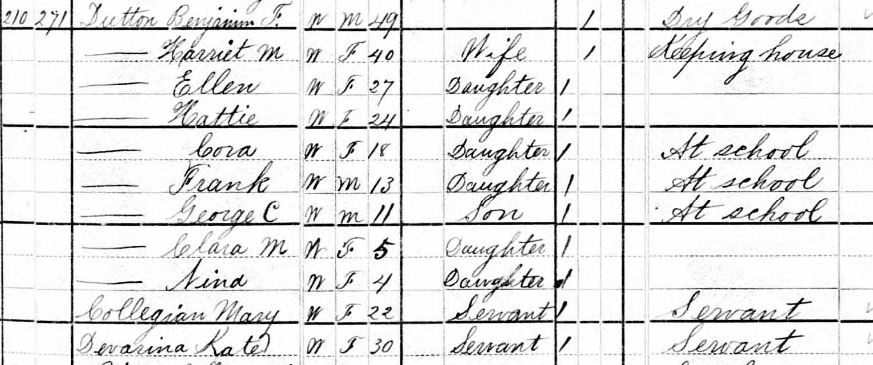
In 1880, two years after purchasing the Glen Rock property, we find B.F. Dutton and his family neatly enumerated in the U.S. Federal Census (click on the image to see an enlargement):

1880 Census

At this early date, B.F. Dutton’s house was still the only residence on the Glen Rock property. All of his children, except Harry, were as yet unmarried and living at home. (And yes, son Frank was called “daughter” by the census taker.) Harry Dutton, married three years earlier, was living in 1880 with his Houghton in-laws in the neighboring town of Melrose.

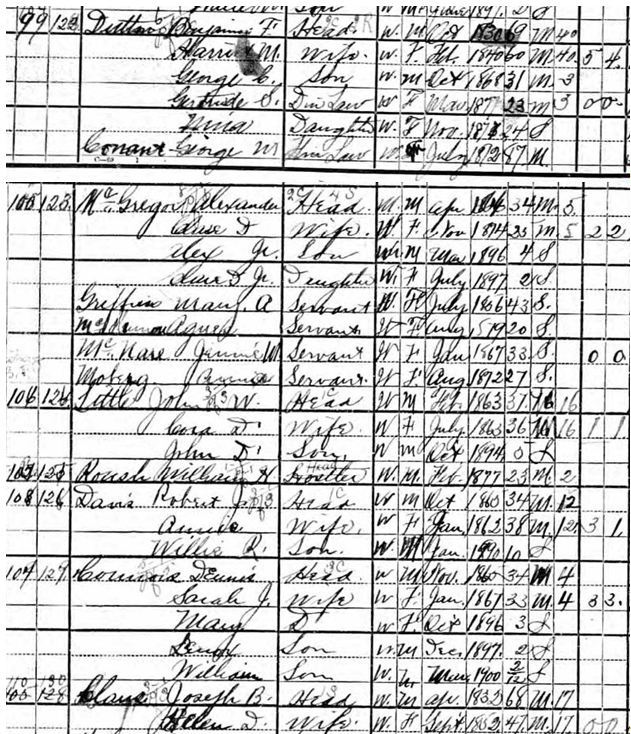
A fire in Washington in 1921 destroyed the original copies of the 1890 census, so our next census look of the family does not become available until 1900, as shown here:

1900 Census combined

At this time in 1900 the family was living in four distinct households at Glen Rock:

1. The B.F. Dutton household, consisting of himself, his wife Harriet, son George C. Dutton, daughter-in-law Gertrude (Stevens) Dutton, daughter Nina, and father-in-law George Conant.

2. The Alexander McGregor household with wife Claire, two children, and four servants.

3. The John W. Little household with wife Cora (Dutton) Little and son John D. Little.

4. The Joseph B. Claus household (further down the page) with wife Ellen (Dutton) Claus.

(The Roush, Davis, and Connors households, listed between the Little and Claus entries, were all headed by persons working for B.F. Dutton in his stable: Roush was a hostler [a handler of horses], Davis was a coachman, and Connors was a horse trainer.)

While this census entry shows that three additional houses had been built by 1900 for Ellen, Claire, and Cora, it does not help us date when they were built.

My grandmother reported that when each of his children married, B.F. Dutton offered to build them a house at Glen Rock. Of those who accepted, Ellen married Joseph Claus in 1883, Cora married John W. Little in 1886, Claire married Alexander McGregor in 1895, and George married Gertrude Stevens in 1897. While this would suggest approximate construction dates for their houses, confirmation of the dates would require additional records. We know from the census that George and Gertrude were still living with B.F. Dutton in 1900, three years after their marriage, so the marriage dates are not necessarily good guideposts as to when the houses were built.

Although we do not have additional census records to illuminate the twenty years between the 1880 and 1900 enumerations shown above, we do have a very valuable census substitute—Malden city directories—that we can use to try to zero in on exactly when each of the houses was built. Most Massachusetts towns in the latter part of the nineteenth century regularly produced city directories, naming all of the heads of household and businesses in town and often providing other valuable information. For Malden there is good run of directories available online, starting in 1868, published approximately every two years through the 1960s.

B.F. Dutton first appears in the Malden city directories in 1880, his entry indicating he was in the “dry and fancy goods” business located at 55 Tremont Street in Boston. His house at Glen Rock was described as being located at the “head of Summer” Street in Malden:

Dutton Benj. F., dry and fancy goods (55 Tremont, B[oston]), house head of Summer [St.]

Four years later, in the 1884 directory, we find two entries of interest:

Dutton Benjamin F., dry and fancy goods (55 Tremont, B[oston]), house head of Summer [St.]
Claus Joseph B., prof. of music (N.E. Conservatory, B[oston]), h[ouse] Glen Rock cottage

Ellen Dutton, who had married Prof. Claus in 1883, was therefore already living by 1884 in the small house that her father built for her on the property. In directory entries in later years, the Clauses’ residence was consistently called “Glen Rock cottage.” So their house was the first to be built on the property for the children, undoubtedly in the period 1883–84. [Note that this contradicts my grandmother’s account in the book that Cora’s house was the first built.] In their 1891 directory entry, Prof. Claus’s two sons from his first marriage were shown as living with them. The younger son, Henry E. Claus, was described as a “teamster” [a person who drives a team or a truck for hauling] and working at 55 Tremont Street in Boston, which was the address of the Houghton & Dutton store. B.F. Dutton was always willing to employ any member of his extended family who wanted to work in the store, and this is another example of that.

Cora Dutton was the next of B.F. Dutton’s children to marry. She and John W. Little were married in the fall of 1886, so it is not surprising to find in the 1886 directory that John W. Little was still listed as living with his parents at 48 Cross Street in Malden (the directory being published before the marriage). His occupation that year was given as “clerk” and his business address was 55 Tremont Street in Boston, showing that he too was employed by the Houghton & Dutton store.

Two years later, in the 1888 directory, his entry is:

Little John W., clerk (55 Tremont St.), boards Glen Rock, Summer [St.]

Although he had now moved from town to the Glen Rock estate, he is described as a boarder, which probably indicates that he and Cora were not yet living in a separate house of their own. That would happen, however, by the time the 1891 directory was published:

Little John W., salesman (55 Tremont St.), house, head of Summer [St.].

Therefore, Cora’s house was the second one built for B.F. Dutton’s children, constructed between 1888 and 1891. John Little would continue to be shown as working for Houghton & Dutton through 1900, when he was listed as an assistant supervisor in the store.

In the period 1900–1902, Cora and John W. Little separated and eventually divorced, and she would marry her second husband, Albert B. Lounsbery, in 1904. When she and John Little separated, it appears that he quit working for Houghton & Dutton and became a full-time musician. In the 1904 directory, they are found under separate entries:

Little Cora Mrs. boards B.F. Dutton’s
Little John W., musician, 126 Cross [St.], b[oar]ds.

According to my grandmother, “soon after [Cora] and Uncle John Little were divorced, [their house] was sold to some people named Sawyer, and they lived there for many years.” By 1908 the Malden directory shows Frederick R. Sawyer living there, his residence described as “house Glen rd head of Summer [St.].”

B.F. Dutton’s daughter Claire married Alexander McGregor in 1895 and their house was built between then and 1897, when we find in the directory:

McGregor, Alexander, ins. agt., house Glen Rock, head of Summer [St.]

The George Dutton house was the last of the children’s houses to be constructed at Glen Rock. Though he and Gertrude were married in 1897, they were still listed as living in B.F. Dutton’s household at the time of the 1900 census, and he was described as a “boarder” in B.F. Dutton’s house in the 1902 directory. Two years later in 1904, George was living at 50 Dexter Street in Malden, a short distance from the Glen Rock property. It would appear his house was built between 1904 and 1906, as in the latter year he was described as living in his house at “Glen Rock head [of] Summer [St.].”

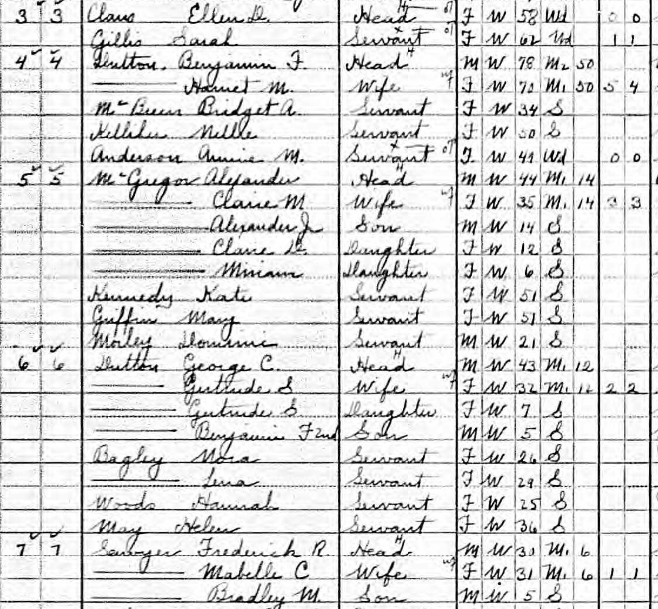
By the time of the 1910 census, we find all five of the Glen Rock houses listed together (shown as numbers 3–7 on the census sheet below) with their current household members—and nearly as many servants!

1910 Census