Harry Dutton’s Camp

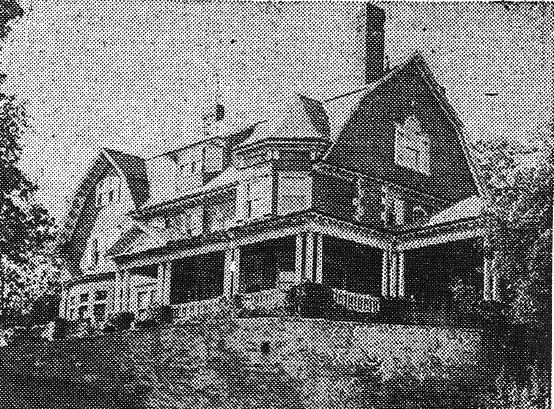
Harry Dutton’s lavish “camp,” located on Metallak Island in Lake Umbagog (just outside the town of Upton, Maine), was a popular summer vacation destination for all of the Duttons.

Upton, Maine

Lake Umbagog2

The camp was built in 1898-99 and remained in the possession of Harry’s descendants until the 1940s when it was eventually sold.

The construction of the camp was an event of much interest to the local population, as evidenced by this story published on the first page of the Lewiston [Maine] Sunday Journal, on 19 November 1898:

Bethel, Me., Nov. 19 (Special). The people of Bethel and vicinity are much interested in Upton, where Mr. Dutton of the well-known firm of Houghton, Dutton & Co., Boston, is erecting a summer house on Metalluck Island in Umbagog Lake. Bethel has often expressed a desire for railroad connection with the large lake country lying northerly of it, but now many think that the future holds more in store for this region if this vast territory is left undisturbed by the railroad. Development inevitably follows in the wake of the railroad and the wilderness of the great forests no longer remains. The territory now lying northerly of Bethel, and made up of Newry, Grafton, Upton and the lower Umbagog region still remains comparatively unbroken in its seclusion. Here the sportsmen can find immense tracts of almost virgin forest, and haunts as wild and rugged and unbroken as they were two centuries ago. Each year many come to this section from other states and enjoy its exceptional sporting facilities. But until recently no move has been made toward the development of the country as a summer retreat.

Mr. Dutton not long ago purchased Metalluck Island of its owners in Upton and at once began to get it into suitable condition for building. The island contains two or three acres and receives its name from the famous Metalluck, the last of the Androscoggin tribe of Indians, who for a long time dwelt on the shores of Umbagog lake and near this point. Mr. Dutton has built a breakwater of rocks around the island, so that its shores are fully protected. The house is being built near the shore and follows its contour to quite a degree. It is one story in height and the front will be 117 feet in length. There will be two wings, one of which will be 97 feet long and the other 77 feet. The building will be of considerable width and will cover quite a surface, thus affording accommodation for a large number. It will contain many fireplaces and will have all conveniences. Mr. Dutton intends to erect a lighthouse on the head of the island and undoubtedly will change the entire island into a veritable paradise of a summer retreat. Mr. Dutton has a nice summer house near Rangeley, but the railroad and its followers are not to his liking when seeking recreation. He had been in Upton looking after his interests but the charge of the entire matter is in the hands of Mr. Alva Coolidge of Upton. A large crew of men are at work upon the building and the outside work is being hastened as much as possible.

Stay tuned for my next blog post, in which I will take you on a boat tour around the island, compliments of Harry’s grandson Dick Morrison, and perhaps we’ll also be able to get in a game of badminton.

The Manager Houses of Glen Rock Circle

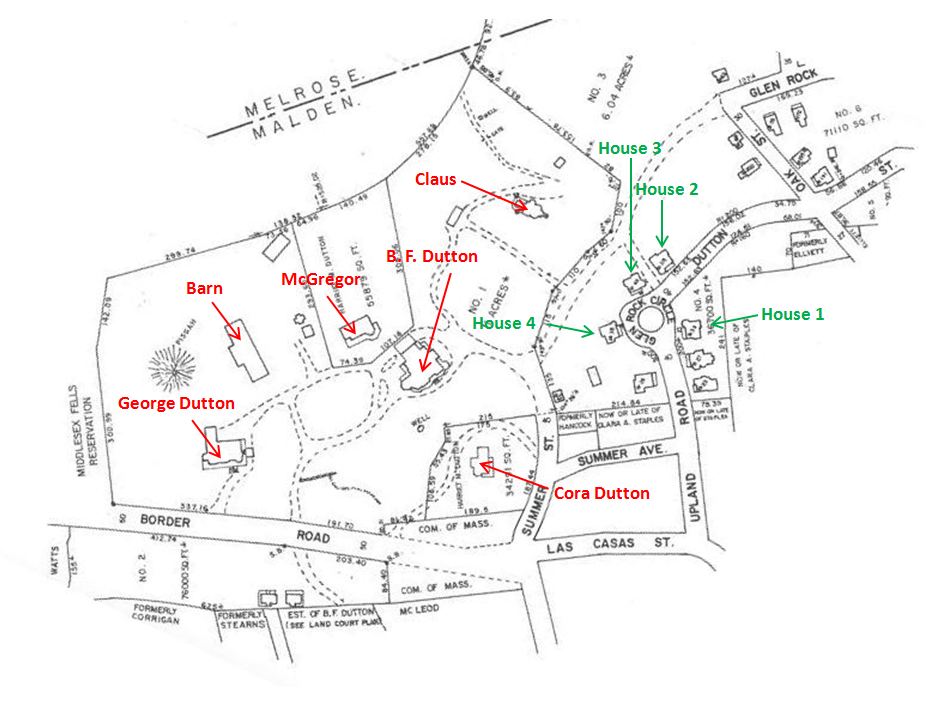
Glen Rock Circle is a small residential circle located at the intersection of Upland Road and Dutton Street in Malden, just to the east of Summer Street and the large Glen Rock property where B. F. Dutton and his children lived. At the time of B. F. Dutton’s death, there were four houses facing immediately on the circle. These are shown on the map here and are labeled as houses #1, #2, #3, and #4.

GlenRock Circle Map

The elderly lady who today lives in house #3 was told when her family bought the house that B. F. Dutton built these four houses for some of the Houghton & Dutton store managers. If he needed to call a meeting of his staff, the managers could come to the main house right away. And looking at the map, one can see that it would be a short walk over to Summer Street and up the Glen Rock driveway to reach B. F. Dutton’s house within minutes.

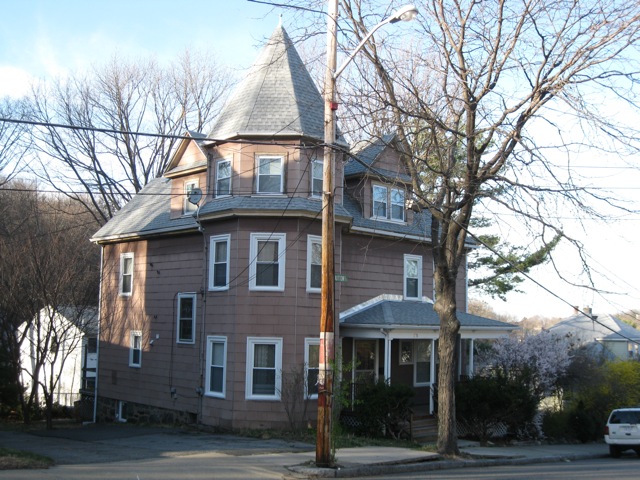
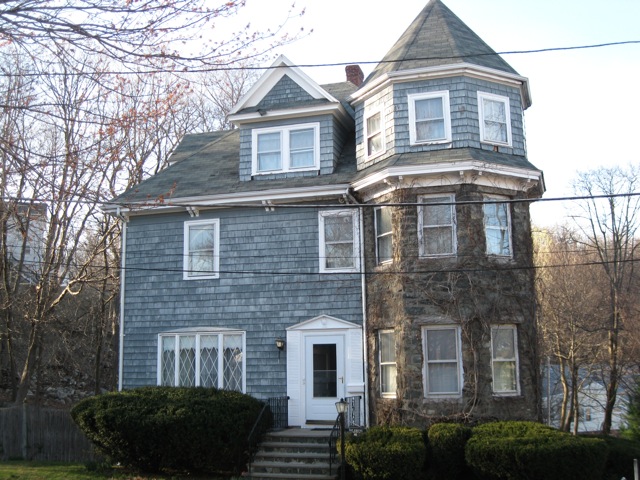
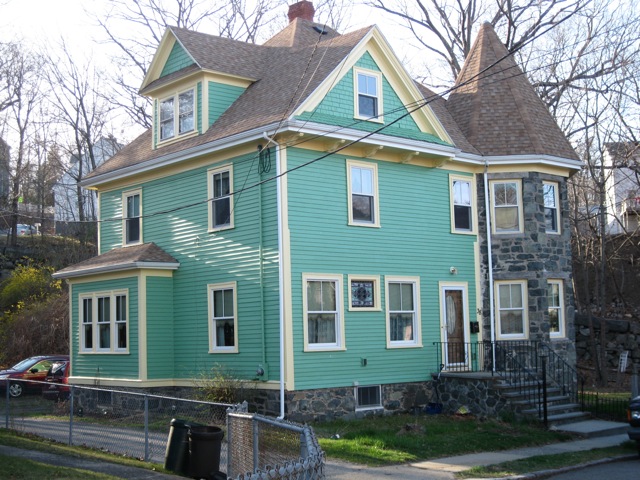
All four of these houses are still standing today and they are remarkably similar architecturally. Photographs, compliments of neighbor Marilyn Glover, are shown below.

House #1’s address is 33 Upland Road:

GlenRock Circle 1

House #2’s address is 115 Dutton Street:

GlenRock Circle 2

House #3’s address is 43 Upland road:

GlenRock Circle 3

And house #4’s address is 38 Glen Rock Circle:

GlenRock Circle 4

In addition to being large houses, the distinguishing feature of all four is the tower structure that graces one corner. This feature is also seen on several of the Glen Rock houses, including those of Alexander McGregor, Cora (Dutton) Little, and George Dutton, as shown below

The Alexander McGregor house:

Glen Rock Alexander McGregor house2

The Cora (Dutton) Little house, seen from below at the intersection of Summer and Las Casas streets:

CoraDutton House

The George Dutton house, in which the tower is less prominent above a second floor bedroom:

GeorgeDuttonHouseGlenRock

This was obviously a style that was favored by B. F. Dutton and it suggests that all of the houses may have been designed by the same architect.

Four Generation Family Photograph

The following photo, contributed by my first cousin Jennifer (Horn) Schuppert, includes four generations of the Dutton/McGregor family. From left to right, the photo shows Clara (Dutton) McGregor, her mother-in-law Mary (McDougall) McGregor, her granddaughter Alexandra (“Sandy”) Matz, and her daughter Claire Dutton (McGregor) Matz. The photo was taken about 1921, so Clara was about 47, Claire was 24, and Sandy about 1.

img052

If readers of this blog have any old family photos to contribute, I would be thrilled to post them. In particular, I would love to receive photos of Alice Dutton and her husband Arthur Morrison, as well as any of their descendants. Also, photos of Trudie (Dutton) Brown, Harriet (Dutton) Bolles, and Junie Dutton would be most welcome. I recently received a cache of photos from Rich Leatherbee (great grandson of Nina Dutton) which I will post in the near future.

Interview with Benjamin F. Dutton – Concluded

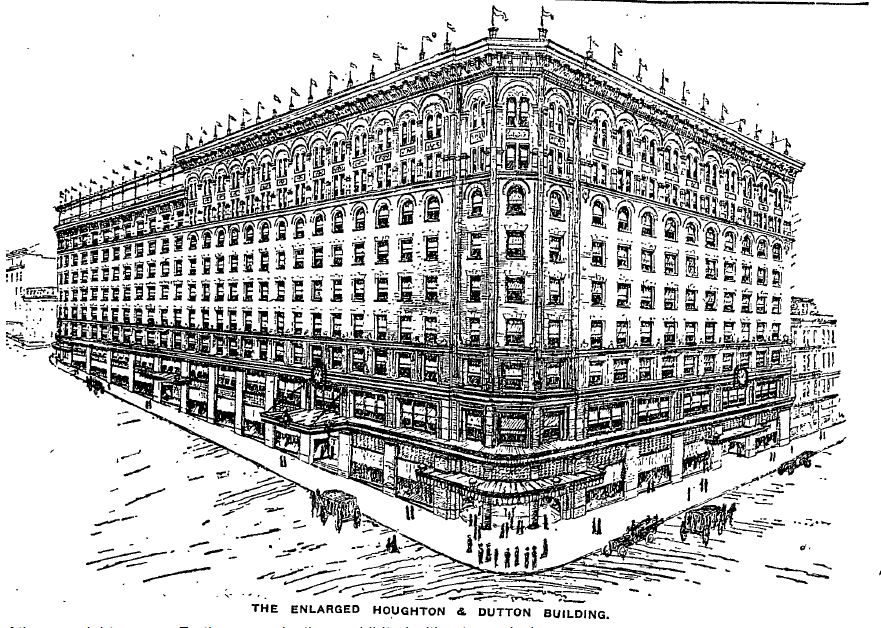
Interviewer: “Do you think you will have achieved your dream of a department store when the new addition is finished?” [The interviewer refers to the large addition to the Houghton & Dutton store that was made in 1913.]

“No, I don’t think I ever could realize my whole dream of a department store. You see, my dream keeps growing, and I am sure it will keep growing as long as I have health and strength. Yet we have accomplished a great deal. When I think of that old Pavilion Building on Tremont street and look at this building today, running up Beacon street from Tremont to Somerset street, around Somerset street and back into Pemberton square and down Tremont street – well it makes me think we have done pretty well; but there is more to be done, and it isn’t all in the building line either.”

Enlarged Store

That shows spirit, and nerve, and enterprise, when you hear a man 82 years old talk like that.

“I feel,” said he, “that we have kept pace with the growth of the city in our business and with the development of our civilization. Those things won’t stop, you know, and the successful department store of the future must keep pace with the growth and development of the city, which means in this case practically the whole of New England, for our trade extends all over New England.”

It might be supposed from all this that B. F. Dutton is the kind of man who thinks of nothing but business. Far from it. He is a firm believer in recreation of a healthy kind. He had always been famous as a sportsman and a fisherman, and he used to get around the golf links in pretty lively style. He is a crack shot and has always been a great lover of horses. In the days before the automobile came into vogue Mr. Dutton was celebrated for his stable of horses, and he has been up against the best of them on the old Mill dam, when sleighing behind a fast trotter was considered the name of Winter sport. And he has always been a great reader and a lover of good music. He has the happy faculty of being able to throw off the cares of business when he turns to recreation of any kind.  And he has tried to impress the importance of being able to do just this thing on his “boys” – on Harry Dutton, on George C. Dutton and on Alexander McGregor.

“Any man will grow stale and lose his sense of perspective if he thinks of nothing but his business,” said Mr. Dutton.

And another thing that should not be overlooked. He remembers his friends, especially in their “dark days,” and he remembers a good many others in the world on whom fortune has not always smiled, but he does all this sort of thing in his own way and without any flourish of trumpets. He knows how to observe silence on certain things that he cherished in his own heart.

One thing is certain, however, Boston has been enriched through the genius of B. F. Dutton and the enterprise of his “boys,” and from what has been said, it is not difficult to see that his influence has not been confined to his own house: it has extended and ramified in many silent ways into other business houses all over the country. And few will doubt that the dream of a department store which he planned at Hillsboro, N.H., more than 50 years ago has been very largely realized on the corner of Tremont street and Beacon street in Boston, Mass. For this completed store will be one of the handsomest, most commodious and most efficient in the country.

Interview with Benjamin F. Dutton – Part 2

Interviewer: “How about the changes that have taken place in the methods of doing business since you started, Mr. Dutton?”

He laughed and said: “There has been a complete revolution in the methods of doing business. In the old days we simply displayed the goods on a counter as you would at a country fair and the customer came in and looked them over and asked the price. There was very little advertising done. Some of the stores considered it beneath their dignity to advertise. Of course Boston was a much smaller city then than it is today. I think the population of Boston has doubled since 1874. In that time the whole character of our civilization has changed and the department store has had to keep pace with the changes that have taken place. There is more of refinement in the tastes of the mass of the people, due to the broadening of education. The mass of the people wouldn’t buy goods today under the conditions that prevailed in 1874. The appearance of a store today has a great deal to do with its success, but in the old days people cared very little for appearances.”

“Then there are the many little conveniences in the department store today all tending to the comfort and happiness of the customers, especially the women and children. The comfort of the customers was scarcely considered in the old days. They just came in, bought what they wanted, and marched off with the goods. You know a standing joke in the comic papers used to be the woman coming home from shopping with her arms full of bundles and her hat askew. Now, nearly everything is delivered free of charge at the home the day the purchase is made, and the woman shopper goes home in a proper frame of mind and doesn’t have to rest two or three days after her experience on a shopping tour.”

Tired Shopper

“It was the department store that first sensed these conveniences for women shoppers, so that today the fitting up of a big store like ours is of the first importance. The comfort and convenience of the customers have been studied at every point. The business of retailing has become a fine art compared with what it used to be, and I think we all feel better and happier for the change.”

“Why, if you were to speak of having rest rooms, and parlors, and restaurants, and lunch counters, and soda fountains in a store in 1874 people would regard you as insane. I remember when we opened our boot and shoe department: that created as big a furor as the millinery department, and nearly everybody predicted that it would be a failure; and it was the same when we opened the drug department and the grocery department and the furniture department.”

At this point Mr. Dutton had to answer the telephone for a few minutes, and when he was through the writer remarked that the telephone must have been of great assistance in the development of the department store.

“I don’t think we could ever have carried out the idea to its present proportions without the telephone,” was the reply. “In this building, when we will have the addition on the corner of Tremont and Beacon streets completed we will have over eight acres of floor space, and I am in touch with the people in every part of that space right here at my desk, without having to go to them or their having to come to me – all through the telephone, the elevator and the electric light have been tremendous factors in the development of the department store.”

“And, you know, I imagine I see a great change in the people since these things have come into use. The people, as a whole, are quicker and more sensitive than they used to be. I don’t think people waste so much time over trifles as they used to. On the other hand the people are probably more nervous than they were formerly.”

Interview with Benjamin F. Dutton – Part 1

The following excerpt is taken from an article in the Boston Daily Globe printed on November 9, 1913, p. 2, and gives interesting insight into Benjamin F. Dutton’s success and personality. It also inspires an amusing mental image of Houghton & Dutton customers wheeling around downtown Boston in rickshaws!

Mr. B. F. Dutton is 82 years old – going on 83 – but he comes to the store nearly every day and “boxes the compass” for “the boys,” so that there will be no mistake about the navigation of the business. He is still the captain of the ship and he lays out the course to be followed, although he had great confidence in the three other officers, his “boys,” as he calls them. There are two sons, Harry Dutton and George Conant Dutton, the vice presidents of the concern, and his son-in-law, Alexander McGregor, treasurer. He has taught all three of these to navigate the business and they can do it so well that whenever the captain goes away for a week or a month or two months he always finds on his return that the navigating officers have done their work well and perhaps have ventured into an unchartered sea with success.

When asked what he attributed the success of his business mainly to, Mr. B. F. Dutton replied:

“I guess it was due at the beginning to hard work as much as anything else. Mr. Houghton and myself were in the store early and late and looked after everything. We had no buyers at that time. He and I did all the buying. One year I did the whole of it myself. That was one of the hardest years I every put in. “Sam” Houghton was a great buyer though. One year he went on an excursion trip to San Francisco, and when he got there he decided to go to Japan. He sent home a shipload of goods, including some jinrikishas, and the people in the other stores laughed at us. We sold every bit of those goods and at a handsome profit, and we have been sending buyers to Japan ever since. I think we were the first firm to send buyers to Japan annually.”

Rickshaw

“One great reason why department stores have, as a rule, been successful is that they have buyers. They trade very little through jobbers. The buyers go straight to the factories in Europe and buy the goods just as the jobber used to. In fact the department store has hurt the jobbing business more than any other business.”

Interviewer: “Do you think the department store has reached its limit?”

“What do you mean?”

Interviewer: “Is there any possibility of chains of department stores?”

“I don’t think so. I don’t like doing business beyond arm’s length. Sam Houghton had an idea something like that and at one time we had small stores in various parts of the city. But it never paid. I know that the chain store idea has been very successful in some lines, but I don’t believe it could be applied to the real department store. That’s big enough business for anybody just as it is.”

“There is one thing further I would like to say about our own success here. I said that at first it was due to hard work. That is always necessary, but in any business in which you are dealing directly with the public something more is necessary. You must get and retain the confidence of the buying public. That can only be secured by fair and honest dealing with the public at all times. You must be consistent in it, for the public is sensitive on that point. It is only carrying out the policy of the best country stores where all met on common footing and every man knows every other man’s business, and where common honesty and fair dealing is the rule.”

Interviewer: “How about the employees – aren’t they a factor in the success of a business of this kind?”

Yes, and a most important factor. Unless there is a spirit of sympathy and cooperation among the employees of a business of this magnitude the business is not going to be a very great success. And there is nothing that hurts an employee more than a lack of sympathy and a lack of the spirit of cooperation with the business in which he is engaged. It works both ways, it hurts the employer and it hurts the employee.”

In our business we have always been fortunate in the spirit of loyalty of our employees, and I think this is even more marked today through the length and breadth of this establishment in which we have more than 2000 employees, than ever before.”

Glen Rock Fountain, Part 2

In a comment to my January 14 post on the Glen Rock fountain, Malden neighbor Kathy Boyle recalled another picture of the fountain taken when it stood in the backyard of the owner. Marilyn Glover has forwarded me that photo, shown here (the street below with the car passing by is East Border Road):

Blog Fountain2

Kathy recounted that the statue had fallen on her when she was a girl and that she still has the scar. She and her young friend, whose family the fountain belonged to at the time, were teaching their Barbie dolls to swim in the fountain when the accident occurred!

Dating the Glen Rock Properties

I have recently made the acquaintance by email of Mr. Jack Ryan, a board member of the Malden Historical Society. He is particularly interested in the town’s architecture and asked if I had any information about architects or builders involved in the construction of the Dutton houses at Glen Rock. He noted that B.F. Dutton’s house was built in the Italianate style—an architectural style that became popular in the United States in the mid-nineteenth century, and which is characterized by flat roofs, wide eaves, and large corbels, reminiscent of the villas of Renaissance Italy. While I have never seen anything about who designed or built the Glen Rock houses, Mr. Ryan indicated he had some ideas on the subject and asked if I could determine precisely when the construction of each house occurred.

B.F. Dutton’s large “mansion house” at Glen Rock was reportedly constructed about 1870 by George Lochman, from whom B.F. purchased the property in 1878. This date comes from a statement in a 1910 Boston Journal article that the house had been built 40 years before (see my book, p. 9, n. 14). Lochman, originally from Pennsylvania, resided in the Boston area for a number of years representing coal interests in his native state, but eventually returned to Philadelphia.

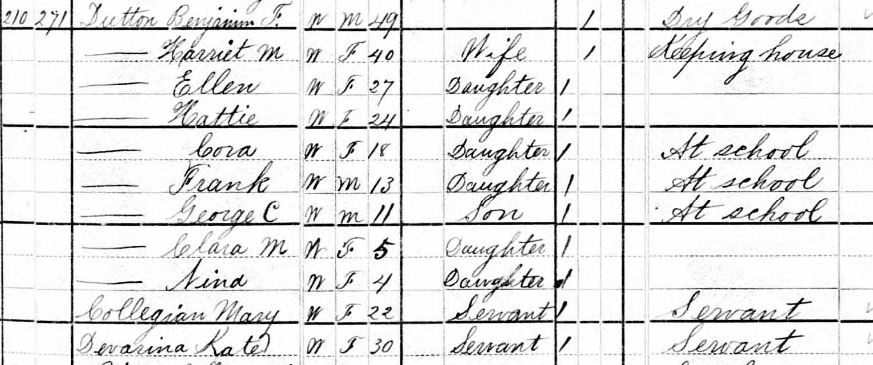
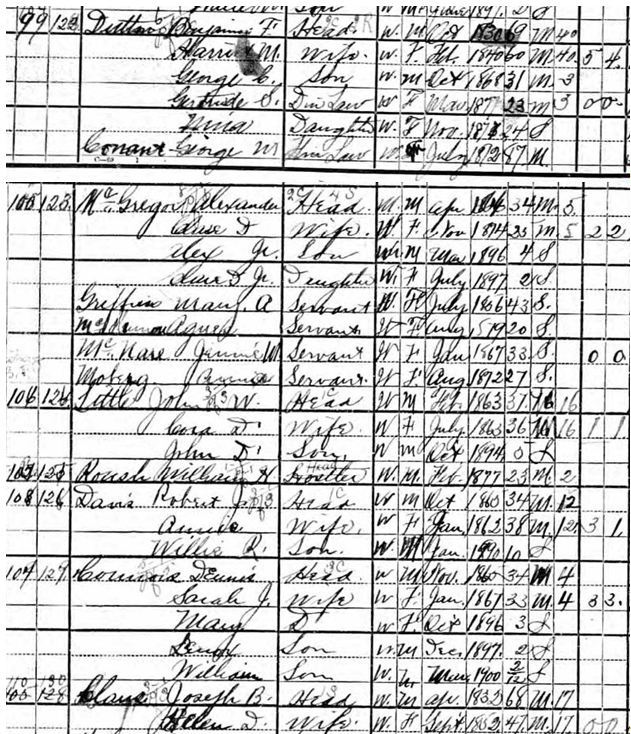
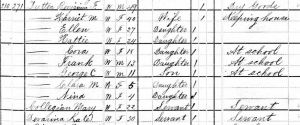
In 1880, two years after purchasing the Glen Rock property, we find B.F. Dutton and his family neatly enumerated in the U.S. Federal Census (click on the image to see an enlargement):
1880 Census

At this early date, B.F. Dutton’s house was still the only residence on the Glen Rock property. All of his children, except Harry, were as yet unmarried and living at home. (And yes, son Frank was called “daughter” by the census taker.) Harry Dutton, married three years earlier, was living in 1880 with his Houghton in-laws in the neighboring town of Melrose.

A fire in Washington in 1921 destroyed the original copies of the 1890 census, so our next census look of the family does not become available until 1900, as shown here:

1900 Census combined

At this time in 1900 the family was living in four distinct households at Glen Rock:

1. The B.F. Dutton household, consisting of himself, his wife Harriet, son George C. Dutton, daughter-in-law Gertrude (Stevens) Dutton, daughter Nina, and father-in-law George Conant.

2. The Alexander McGregor household with wife Claire, two children, and four servants.

3. The John W. Little household with wife Cora (Dutton) Little and son John D. Little.

4. The Joseph B. Claus household (further down the page) with wife Ellen (Dutton) Claus.

(The Roush, Davis, and Connors households, listed between the Little and Claus entries, were all headed by persons working for B.F. Dutton in his stable: Roush was a hostler [a handler of horses], Davis was a coachman, and Connors was a horse trainer.)

While this census entry shows that three additional houses had been built by 1900 for Ellen, Claire, and Cora, it does not help us date when they were built.

My grandmother reported that when each of his children married, B.F. Dutton offered to build them a house at Glen Rock. Of those who accepted, Ellen married Joseph Claus in 1883, Cora married John W. Little in 1886, Claire married Alexander McGregor in 1895, and George married Gertrude Stevens in 1897. While this would suggest approximate construction dates for their houses, confirmation of the dates would require additional records. We know from the census that George and Gertrude were still living with B.F. Dutton in 1900, three years after their marriage, so the marriage dates are not necessarily good guideposts as to when the houses were built.

Although we do not have additional census records to illuminate the twenty years between the 1880 and 1900 enumerations shown above, we do have a very valuable census substitute—Malden city directories—that we can use to try to zero in on exactly when each of the houses was built. Most Massachusetts towns in the latter part of the nineteenth century regularly produced city directories, naming all of the heads of household and businesses in town and often providing other valuable information. For Malden there is good run of directories available online, starting in 1868, published approximately every two years through the 1960s.

B.F. Dutton first appears in the Malden city directories in 1880, his entry indicating he was in the “dry and fancy goods” business located at 55 Tremont Street in Boston. His house at Glen Rock was described as being located at the “head of Summer” Street in Malden:

Dutton Benj. F., dry and fancy goods (55 Tremont, B[oston]), house head of Summer [St.]

Four years later, in the 1884 directory, we find two entries of interest:

Dutton Benjamin F., dry and fancy goods (55 Tremont, B[oston]), house head of Summer [St.]
Claus Joseph B., prof. of music (N.E. Conservatory, B[oston]), h[ouse] Glen Rock cottage

Ellen Dutton, who had married Prof. Claus in 1883, was therefore already living by 1884 in the small house that her father built for her on the property. In directory entries in later years, the Clauses’ residence was consistently called “Glen Rock cottage.” So their house was the first to be built on the property for the children, undoubtedly in the period 1883–84. [Note that this contradicts my grandmother’s account in the book that Cora’s house was the first built.] In their 1891 directory entry, Prof. Claus’s two sons from his first marriage were shown as living with them. The younger son, Henry E. Claus, was described as a “teamster” [a person who drives a team or a truck for hauling] and working at 55 Tremont Street in Boston, which was the address of the Houghton & Dutton store. B.F. Dutton was always willing to employ any member of his extended family who wanted to work in the store, and this is another example of that.

Cora Dutton was the next of B.F. Dutton’s children to marry. She and John W. Little were married in the fall of 1886, so it is not surprising to find in the 1886 directory that John W. Little was still listed as living with his parents at 48 Cross Street in Malden (the directory being published before the marriage). His occupation that year was given as “clerk” and his business address was 55 Tremont Street in Boston, showing that he too was employed by the Houghton & Dutton store.

Two years later, in the 1888 directory, his entry is:

Little John W., clerk (55 Tremont St.), boards Glen Rock, Summer [St.]

Although he had now moved from town to the Glen Rock estate, he is described as a boarder, which probably indicates that he and Cora were not yet living in a separate house of their own. That would happen, however, by the time the 1891 directory was published:

Little John W., salesman (55 Tremont St.), house, head of Summer [St.].

Therefore, Cora’s house was the second one built for B.F. Dutton’s children, constructed between 1888 and 1891. John Little would continue to be shown as working for Houghton & Dutton through 1900, when he was listed as an assistant supervisor in the store.

In the period 1900–1902, Cora and John W. Little separated and eventually divorced, and she would marry her second husband, Albert B. Lounsbery, in 1904. When she and John Little separated, it appears that he quit working for Houghton & Dutton and became a full-time musician. In the 1904 directory, they are found under separate entries:

Little Cora Mrs. boards B.F. Dutton’s
Little John W., musician, 126 Cross [St.], b[oar]ds.

According to my grandmother, “soon after [Cora] and Uncle John Little were divorced, [their house] was sold to some people named Sawyer, and they lived there for many years.” By 1908 the Malden directory shows Frederick R. Sawyer living there, his residence described as “house Glen rd head of Summer [St.].”

B.F. Dutton’s daughter Claire married Alexander McGregor in 1895 and their house was built between then and 1897, when we find in the directory:

McGregor, Alexander, ins. agt., house Glen Rock, head of Summer [St.]

The George Dutton house was the last of the children’s houses to be constructed at Glen Rock. Though he and Gertrude were married in 1897, they were still listed as living in B.F. Dutton’s household at the time of the 1900 census, and he was described as a “boarder” in B.F. Dutton’s house in the 1902 directory. Two years later in 1904, George was living at 50 Dexter Street in Malden, a short distance from the Glen Rock property. It would appear his house was built between 1904 and 1906, as in the latter year he was described as living in his house at “Glen Rock head [of] Summer [St.].”

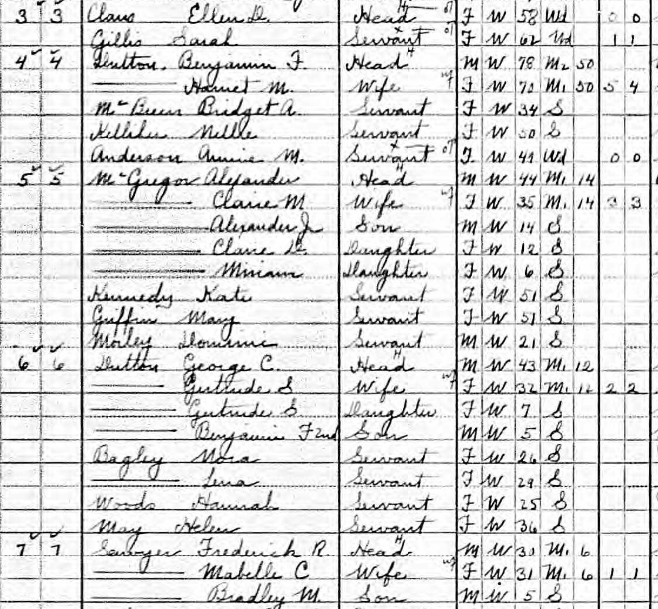
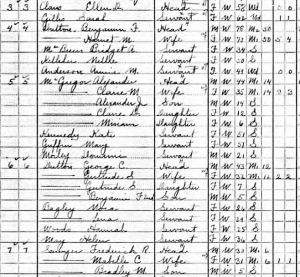
By the time of the 1910 census, we find all five of the Glen Rock houses listed together (shown as numbers 3–7 on the census sheet below) with their current household members—and nearly as many servants!
1910 Census

Glen Rock Then and Now

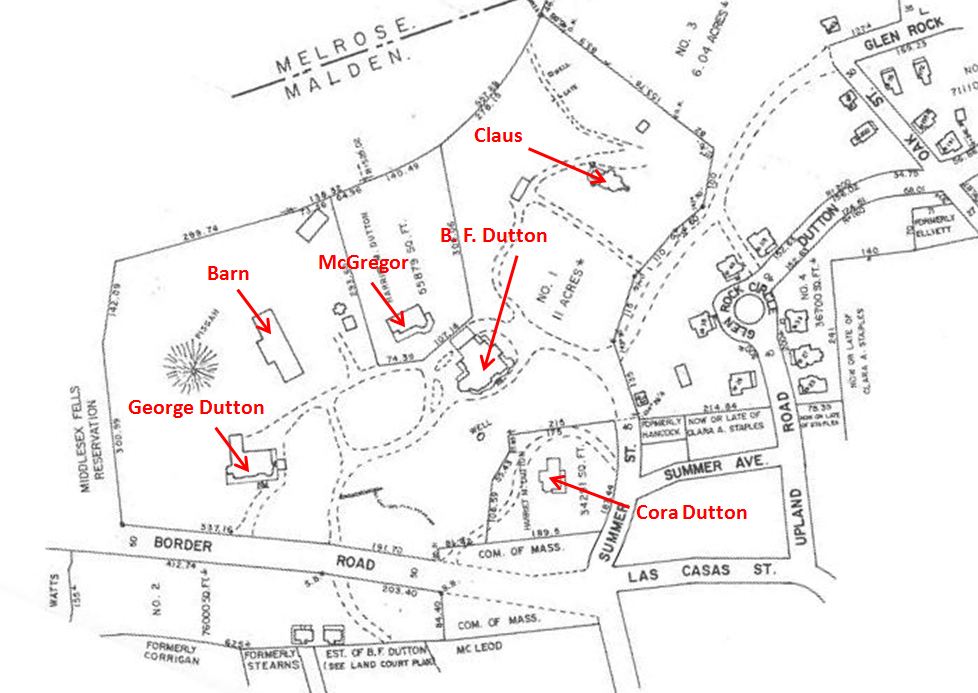
One hundred years ago, the Glen Rock estate was made up of B.F. Dutton’s large house, the barn, and the houses that were built for his children. The children who lived on the property after they married were Ellen (Dutton) Claus, Cora (Dutton) Little, George C. Dutton, and Clara (Dutton) McGregor. These properties are all visible on the map that was drawn up in June 1915 by A. F. Sargent, surveyor, as part of B.F. Dutton’s estate proceedings, as shown here.

Blog Glen Rock then

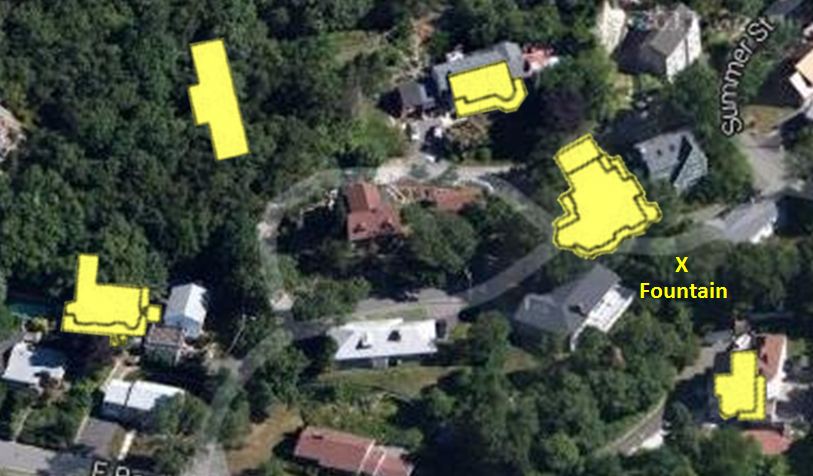
Today, all of the Dutton properties are gone and the original estate has been split into smaller plots with many new houses having been constructed. An aerial view of the area shows the Glen Rock estate as it is today.

Blog Glen Rock now

The photograph shows that most of the roads and the circular driveway that existed back in B.F. Dutton’s times are still in place, although a close look reveals that the driveway circle has been somewhat elongated.

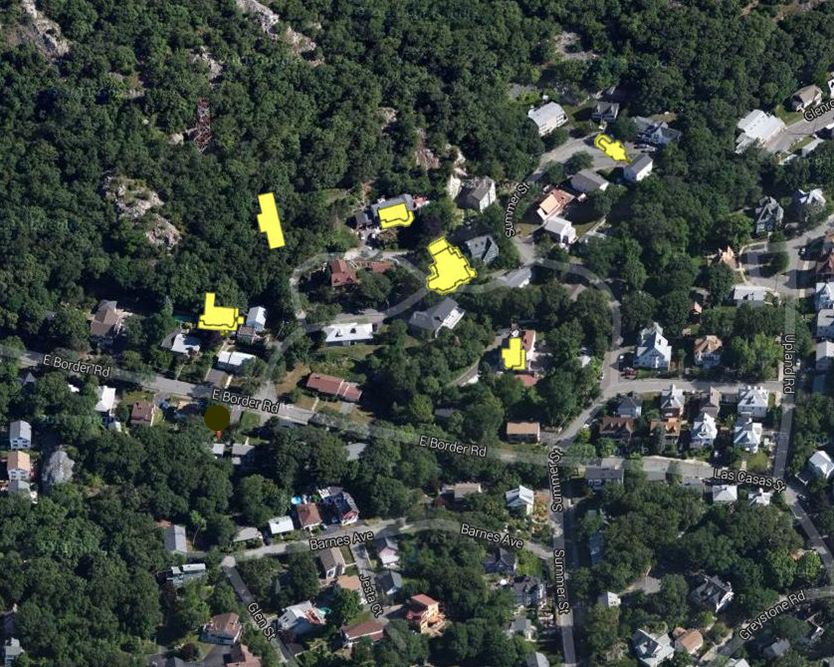
By carefully sizing and aligning the surveyor’s drawing with the aerial view, I am able to determine the exact location of the Dutton houses on the property today, and this is shown here with the Dutton houses being superimposed in yellow on the photograph.

Blog superimposed

B.F. Dutton’s house was located just between the two houses now standing on the right side of the circle. New houses have been built on the sites of the McGregor house and the Cora Dutton house, while there is no structure where the George Dutton and Claus houses stood. The site of the barn has been totally reclaimed by the woods, although some ruins of it remain and this will be addressed in a future blog post. The large rocky outcrop to the left of the barn and behind and to the left of the George Dutton house is what was called Tea Rock (now called Pinnacle Rock), and we will take a tour to Tea Rock’s summit also in a future post.

And in case anyone is wondering, the original location of the fountain, described in my previous post, is shown here.

Blog Fountain

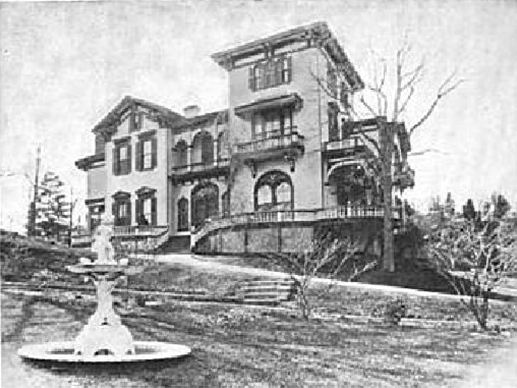
The Glen Rock Fountain

Granpa's House2
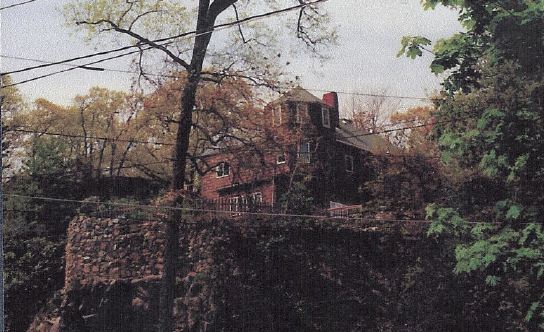
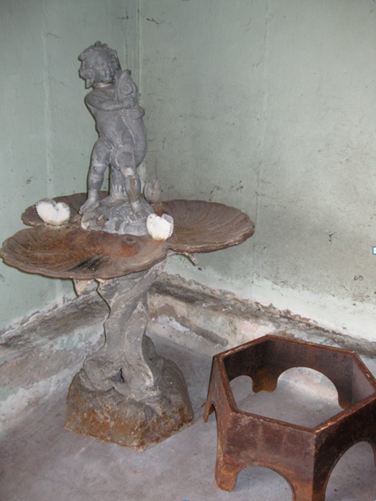
Although B.F. Dutton’s house at Glen Rock was torn down in the 1930s, the fountain that stood on the front lawn (see foreground of the photo above) miraculously survives. One of the Glen Rock neighbors has the fountain today, and it was on her parents’ property when they bought their house in the fifties. Their house was located on top of the hillock where the flagpole was in the Dutton days. The base was used as a planter by this neighbor when she moved into a newer house across the way from her family home after she married. Her family home was sold; but she kept the fountain, which she said took five men to move. It’s now in her cellar.

Fountain
Fountain Base
If any reader would like to purchase the fountain and preserve this bit of family history, maybe the present owner would entertain an offer, though I doubt shipping would be included!

These photographs are courtesy of Marilyn Glover, who lives across the street from the main Glen Rock entrance on East Border Road and about whom you will hear more in future posts.